|
Zihui Gao I'm a Research Fellow at Nanyang Technological University (NTU), Singapore, working with Jiawang Bian. I work on 3D vision: recovering the geometry and appearance of the real world from images and videos, and turning it into representations that machines can perceive, simulate, and interact with. I did my PhD at Zhejiang University, in the State Key Lab of CAD & CG, where I was advised by Hao Chen and Chunhua Shen. |
|
ResearchI'm interested in 3D computer vision, world models, and embodied AI. My work spans 3D reconstruction (sparse-view surface reconstruction and Gaussian splatting, and scaling 3D geometric foundation models with Internet video), 3D perception for autonomous driving (monocular 3D object detection and vision-language driving), and interactive video world models together with the large-scale data that trains them. Going forward, I'm particularly excited about real-to-sim: reconstructing real-world scenes and objects into faithful, interactive simulations, so that robots and embodied agents can be trained and evaluated in digital twins of the world they will act in. |
|
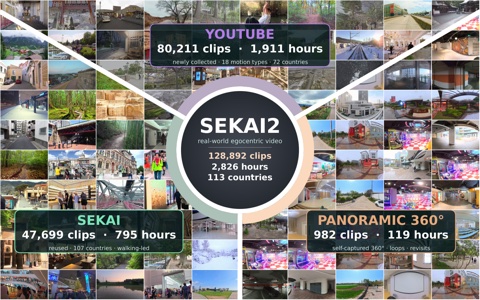
Sekai2: From World Exploration to Interactive World Modeling
Kang He, Wenshuo Peng, Zihui Gao, Jiaming Tan, Kaipeng Zhang, Yongtao Ge arXiv, 2026 arXiv A large-scale egocentric video dataset pairing long videos with camera trajectories and temporally grounded captions, for training long-horizon, camera-controllable video world models. |

|
AlayaWorld: Interactive Long-Horizon World Modeling — Full Technical Report
AlayaWorld Team: Kaipeng Zhang, Chuanhao Li, Yifan Zhan, Yongtao Ge, Yuanyang Yin, Jiaming Tan, Kang He, Liaoyuan Fan, Mingliang Zhai, Ruicong Liu, Xiaojie Xu, Xuangeng Chu, Zhen Li, Zhengyuan Lin, Zhixiang Wang, Zian Meng, Zihui Gao arXiv, 2026 arXiv The full technical report of AlayaWorld, a video world model that generates interactive, explorable, and continuously evolving virtual worlds from text, an image, or video. |
|
RA-L 2026
|
RGB-D Video Generation for Improving Human-to-Robot Object Handover Prediction
Tianyu Sun, Zhoujie Fu, Zihui Gao, Bang Zhang, Guosheng Lin IEEE Robotics and Automation Letters (RA-L), 2026 paper Hand2Bot, an RGB-D video dataset with rich human context (body posture, facial expressions) collected for human-to-robot handover, plus RGB-D video generation to narrow the sim-to-real gap. |
|
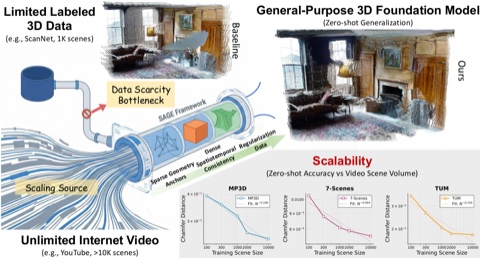
Scalable Adaptation of 3D Geometric Foundation Models via Weak Supervision from Internet Video
Zihui Gao, Ke Liu, Donny Y. Chen, Duochao Shi, Guosheng Lin, Hao Chen, Chunhua Shen NeurIPS, 2026 arXiv SAGE turns unlabeled Internet videos into training data for 3D geometric foundation models, combining sparse SfM anchors with dense consistency from 3D Gaussian rendering. |
|
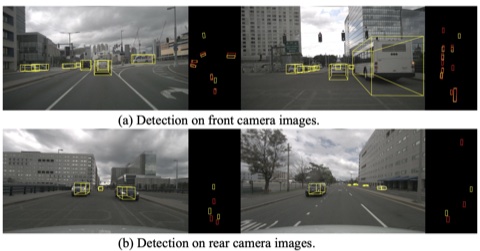
IPD3D: Camera-Agnostic Lightweight Monocular 3D Detection via Geometric Decoupling
Zihui Gao, Xinhai Zhao, Hao Chen IJCNN, 2026 Monocular 3D detectors work best on images from the camera they were trained on. Decoupling the intrinsic parameters, by mapping images or features to an aligned focal length, lets one lightweight detector work across cameras. |
|
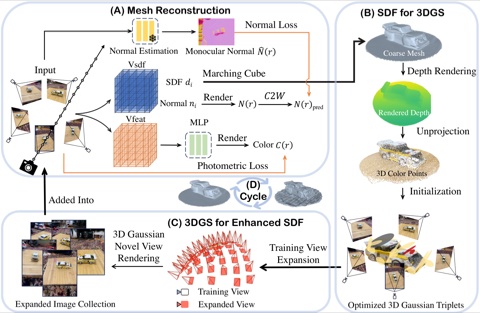
SurfaceSplat: Connecting Surface Reconstruction and Gaussian Splatting
Zihui Gao, Jia-Wang Bian, Guosheng Lin, Hao Chen, Chunhua Shen ICCV, 2025 paper / arXiv / code For sparse-view inputs, an SDF supplies coarse geometry to improve 3DGS rendering, and images rendered by 3DGS in turn refine the SDF's fine surface detail. |
|
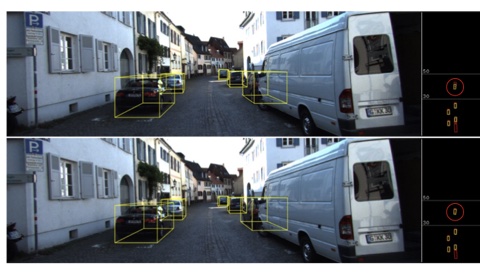
Improving Monocular 3D Object Detection for Far-Field Scenarios
Zihui Gao, Xinhai Zhao, Hao Chen ITSC, 2025 paper Better instance-depth estimation for far-away objects (over 30m), which are small and rarely annotated, in monocular 3D detection. |
|
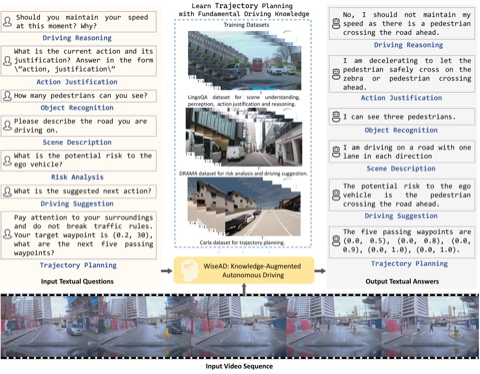
WiseAD: Knowledge Augmented End-to-End Autonomous Driving with Vision-Language Model
Songyan Zhang, Wenhui Huang, Zihui Gao, Hao Chen, Chen Lv arXiv, 2024 arXiv Studies how driving knowledge in a vision-language model relates to closed-loop driving, and injects that knowledge into an end-to-end autonomous driving system. |
|
DSP 2022
|
Detection Architecture with Improved Classification Capabilities for Covariance Structures
Jun Liu, Zihui Gao, Zhaoqian Sun, Tao Jian, Weijian Liu Digital Signal Processing, 2022 paper A radar adaptive detection architecture that first classifies the interference covariance structure and then picks the matching adaptive detector. |
|
Website template from Jon Barron. |